Data Reliability Platform
The most dangerous data failures are silent: jobs finish 'successfully' while the reports show something false. This enterprise platform on AWS catches such inconsistencies daily — automated validation, integration tests and monitoring, with results you can check rather than take on trust. The firm's founder worked on it as an engineer within a larger team, responsible for data-validation automation and testing.
Automated data validation and testing in an enterprise environment
- Client
- An international enterprise environment; project details are covered by confidentiality
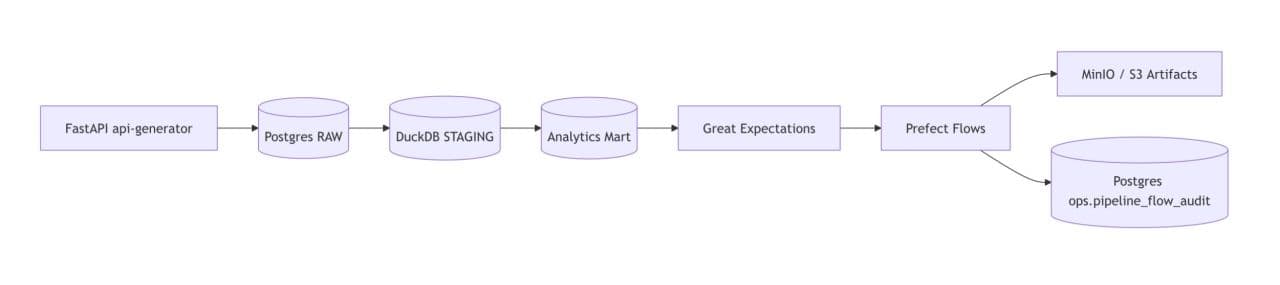
Project context
Companies make decisions based on reports, and reports are exactly as good as the data flowing into them through pipelines. The most dangerous data failures are silent: jobs finish successfully and dashboards keep rendering — they just show something false. This project was about a platform whose job is to detect those situations before anyone acts on them.
The platform runs in an enterprise environment on AWS and continuously validates data moving through cloud pipelines: it checks schemas, completeness, consistency between processing stages and data freshness, and reports deviations to the team before the consumers of the reports notice them.
Our part of the work concerned the engineering side of that reliability: automating validation, integration-testing the pipelines and monitoring. We describe it as far as confidentiality allows — no client name, no client data, no detail of their systems.
Business challenge
The scale and variety of the data ruled out manual checking: many datasets from different sources, processed in stages, with dependencies between those stages. On top of that, the most serious defects do not crash anything — missing rows, duplicates or broken references pass through a pipeline silently and only surface in reports.
At the same time, validation could not slow delivery down. Checks had to run inside the pipelines and the CI process, not alongside them — with a clear distinction between problems that stop the flow of data and problems that only raise an alarm. Rules that were too strict would block work; rules that were too loose would let defects through.
Scope of delivery
Our scope on this project covered data-validation automation and testing: designing the data-quality checks, implementing the test framework in Python and PyTest, and wiring it into the pipelines and the CI/CD process. The platform as a whole was the work of a larger team; what is described here is that part only.
The scope also included making the results usable: metrics and alerts in Amazon CloudWatch, plus reporting that shows the team exactly what is off, where, and since when.
Founder's role
This scope was delivered personally by the firm's founder, Jakub Zając, working as an engineer inside the client's larger team and responsible for data-validation automation and testing.
Capabilities involved
Quality engineering
Knowing what is covered by tests — and what deliberately is not.
Test automation
Regression checked on every change, not once before a release.
Cloud and DevOps
Repeatable deployments and environments you can rebuild.
Database engineering
Data models and queries that don't slow down as the business grows.
Data reliability
Checks that catch a data defect before it reaches a board report.
The disciplines this delivery required — a list of disciplines, not of job titles.
Solution
A data-validation framework in Python
We built the data-quality checks as code: schema checks, completeness, uniqueness, referential consistency across datasets and data freshness. PyTest serves as the execution engine, so validations are run, reported and maintained exactly like ordinary tests — no bespoke tool anyone would have to learn separately.
Integration tests for the data pipelines
The processing path — from files in Amazon S3, through AWS Glue jobs, to tables in Amazon Redshift — is tested end to end on controlled datasets. A test pushes data through the real pipeline and verifies that the output is exactly what it should be, not merely that the job completed.
Validation built into the process, not next to it
The checks run in two modes: in CI (GitHub Actions) on every change to the processing logic, and on a schedule against production data flows. Serious violations stop the pipeline, smaller deviations raise a warning — so defects do not travel downstream, and the team is not blocked by every minor anomaly.
Data-quality monitoring and alerting
Validation results feed metrics and alarms in Amazon CloudWatch. The team can see the state of the checks over time and gets notified when something drifts out of line — a data problem is reported by monitoring, not by a puzzled report consumer a week later.
Reporting and handling inconsistencies
A detected inconsistency has a path to follow: the report shows which check failed, on which dataset and since when, cutting diagnosis from hours of digging through data to reading a result. That turns data quality from a topic everyone shrugs about into a measurable, managed process.
Repeatable test infrastructure
The environments the validations run in are described in Terraform and containerized with Docker. The framework can be brought up in another environment without manual configuration, and the test infrastructure goes through review just like the check code itself.
Technology stack
Testing and validation
- Python
- PyTest
- SQL
Cloud and data (AWS)
- Amazon S3
- AWS Glue
- Amazon Redshift
Security and monitoring
- AWS IAM
- Amazon CloudWatch
Infrastructure and CI/CD
- Docker
- Terraform
- GitHub Actions
Technical approach
- Validations are code, versioned together with the pipeline logic. Every rule goes through review and has a history — it is clear who added it, why, and what exactly it checks.
- Two severity levels instead of one: hard violations stop the data flow, soft anomalies only alert. That distinction protects against silent defects and against constantly blocking the team at the same time.
- Integration tests work on deterministic, controlled datasets rather than copies of production — test results are repeatable, and sensitive data does not wander between environments.
- The checks are designed to be cheap and idempotent, so they can run often. Frequent automated verification beats a thorough review done once a month.
- We chose standard tools — PyTest over a bespoke runner. Any engineer who knows Python can add a check on day one of working with the platform.
Quality and reliability
- Access follows least privilege in AWS IAM: validation components read only the datasets they check — nothing more.
- Production data never leaves the controlled environment. Tests use synthetic or anonymized datasets prepared specifically for that purpose.
- Secrets and credentials are handled by managed cloud and CI mechanisms — they never appear in code or in the repository's configuration files.
- Infrastructure changes go through Terraform and code review, providing a complete audit trail — which in an enterprise environment matters no less than the system working.
Outcome
Data inconsistencies now surface at the pipeline stage, not in reports. A whole class of silent defects, previously caught by accident, is caught systematically.
The team has a repeatable way to bring new datasets under validation — the platform grows with the data instead of being a one-off project.
Trust in the data stops being a matter of faith: consumers can check the state of the validations instead of assuming things are probably fine.
Gallery
Sample data-validation report (anonymized data)
1600×1000 px, AVIF/WebP
CloudWatch data-quality metrics dashboard (anonymized)
1920×1080 px, AVIF/WebP
Validation test run in CI (anonymized)
1920×1080 px, AVIF/WebP
Related services
The scope this project drew on, described in more depth on the service pages.
QA and software testing
Manual and automated testing, API, UI and regression tests, plus test strategy — a quality process that actually protects your releases.
Databases and data
PostgreSQL design and optimisation, migrations, reporting and automated data validation, so the numbers across your company finally agree.
DevOps and cloud
CI/CD, Docker, Terraform and AWS, so releases become a single click and you hear about failures before your customers do.
More work

IZAPzoo
Loyalty app and admin platform
IZAP, a brick-and-mortar retail chain, wanted its own loyalty programme on customers' phones instead of plastic cards. We designed and built the whole thing — Android and iOS apps, a cloud backend and an admin platform — and store staff now run points, rewards and promotions themselves.
Read the case study
ThomasSeekerAI
Private opportunity-discovery tool with AI-assisted analysis
A private trader was combing OLX, Otomoto, Allegro and a handful of smaller sites by hand, every day, for things worth reselling. We built an internal tool that takes that work over: searches described in a plain sentence run on a schedule in the background, the noise is filtered out, and what is left is ranked by how good the opportunity looks — hours of manual browsing turned into an automated job.
Read the case study
Let's talk about your project
Happy to walk you through how a similar approach would work in your case — and what we would avoid.